Line Producing and Editing
In this week’s exercise Learning through Imitation we had to replicate a scene from Ingmar Bergman’s Persona (1966). I fulfilled the roles of the line producer and the editor. While the focus of this exercise was lighting, my roles brought their own unique challenges. This was also the first time that I was the editor on a short film and not just an overseer in the form of a producer or director.
Part 1: Line Producing
In preparation for this week’s short film I worked closely with Juliette our producer to schedule the shoot. Since she was also starring as the main character of the scene, I took on the role of the line producer so that we had someone on set who can fulfil the responsibilities that usually our producer would have faced.
Considering the task, we had to replicate the scene in the two-hour time window that we had for our shoot. In order to create a proper schedule Juliette and I took screenshots of each shot of the scene and used those to create a storyboard. That was a huge help when it came to finding the shoot order. Visualizing all the shots on a few pages made it easier to single out all the unique set-ups of the shots. That way we could group shots that used the same set-ups and schedule them to be shot together. Because of that we didn’t need to spend a lot of time on changing the set-ups in the shoot which was a good step to maximizing our actual shoot time.
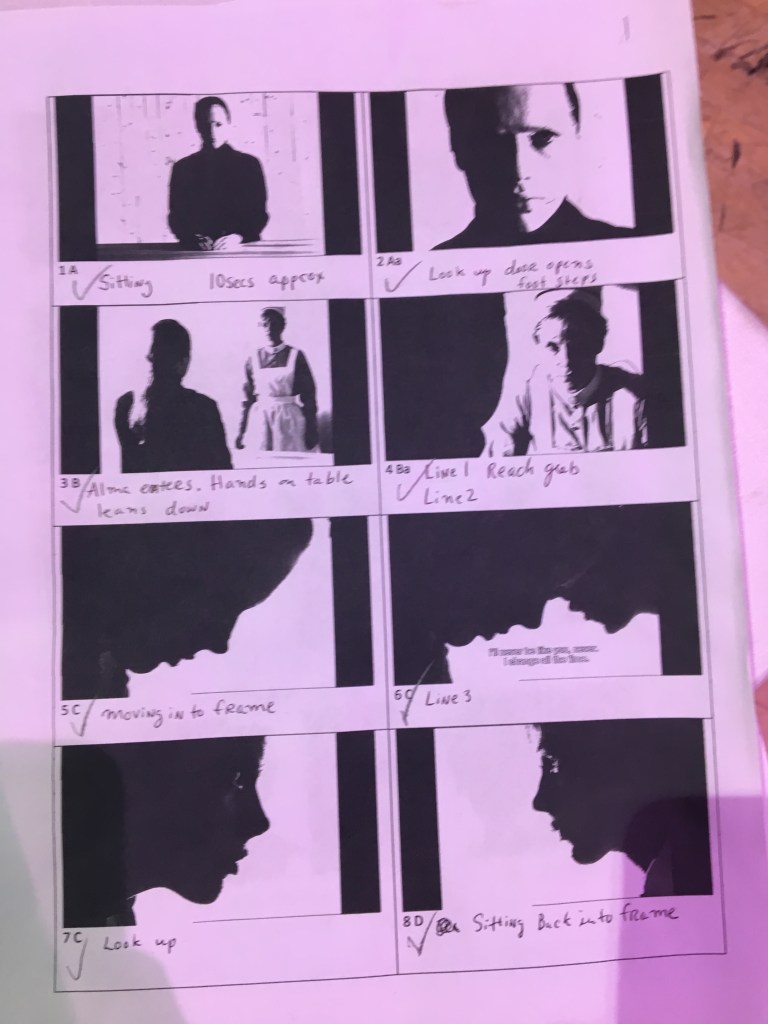
Storyboard/Shotlist, page 1 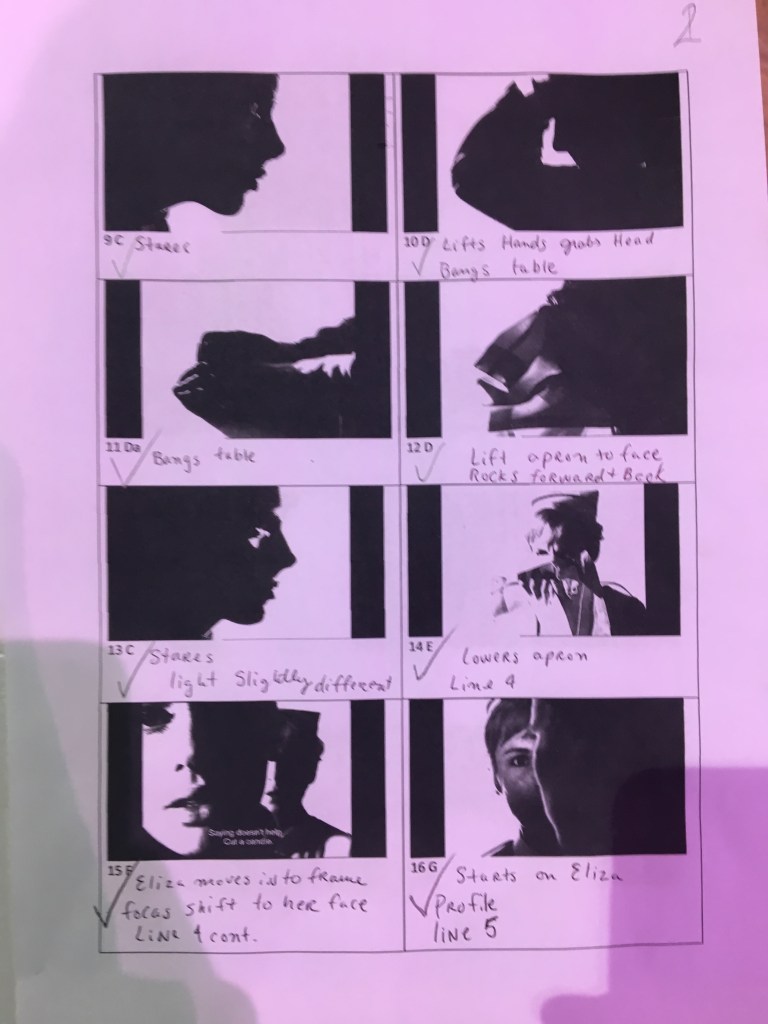
Storyboard/shotlist, page 2 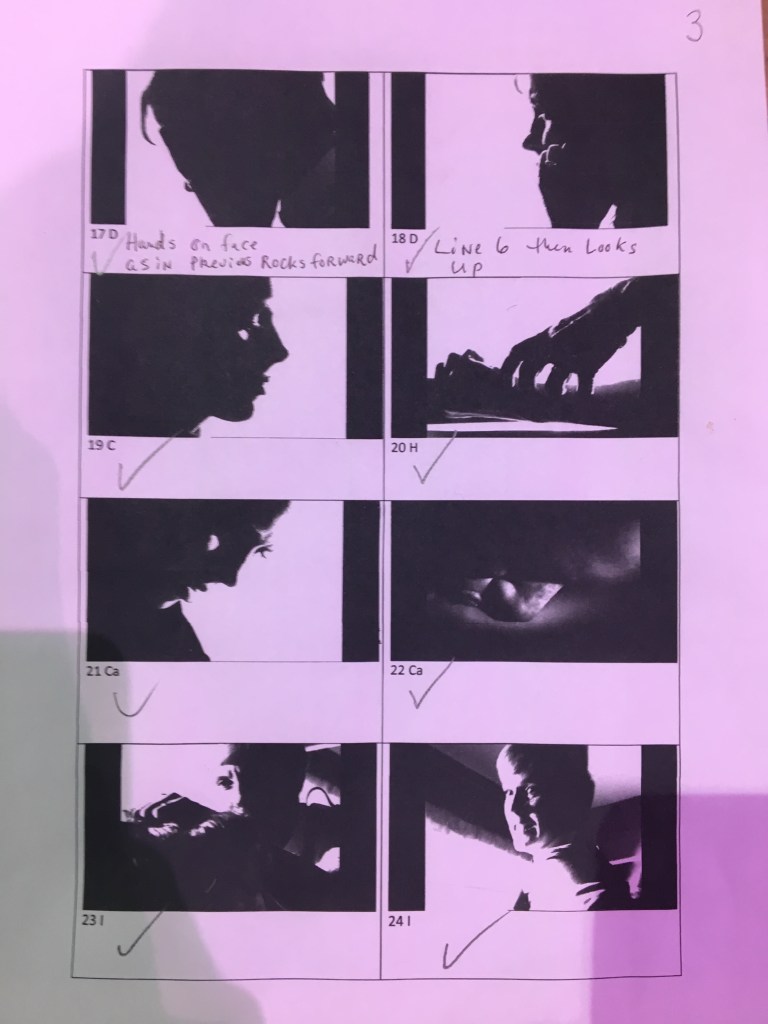
Storyboard/shotlist, page 3 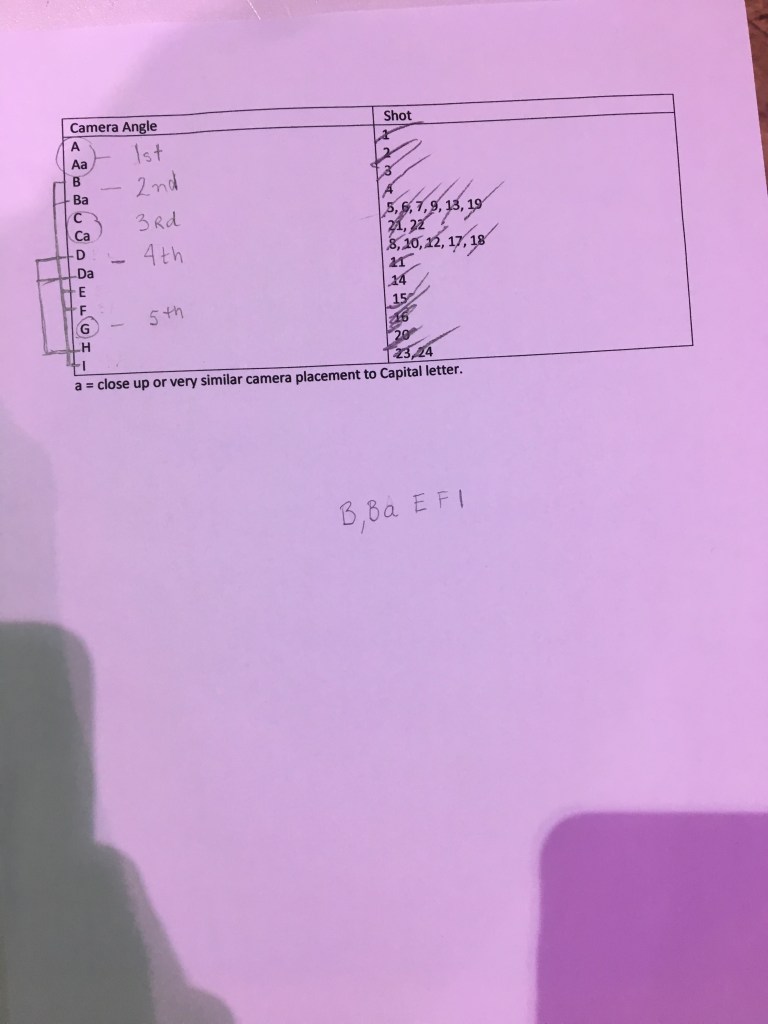
Shoot order / Checklist
The biggest challenge for me as the line producer was the time management during our film shoot. Since this was the first time that we worked with actual lighting equipment and previous to that we only had a bit of theory on lighting, it was very challenging for our crew to find the right position for the lights in order to replicate Bergman’s lighting as closely as possible. Initially this process took considerably longer than anticipated which resulted in our first set-up taking up almost one hour of our two-hour time window. As the person in charge of the schedule and the time management that was quite the stressful hour. I tried to help as much as I could with the lighting set-up to speed up the process and gave our crew ultimatums for when they had to start filming each shot of the first set-up. I ended up giving them a lot more time for the first set-up than originally planned because when we actually were on set I quickly realized that it would be best to give our crew more time in the beginning to help them get accustomed to the new equipment and methods of filming, in order to improve the quality of the results.
In the second hour of the shoot I sped up the production and gave them much stricter time limits since we only shot about a fourth of the footage at that point with only half of the time window remaining. As time went on our crew got better in keeping the time limits for each set-up and in the end, we managed to finish our shoot on time.
This practice was deeply rewarding for me. I got hands-on experience for situations under time pressure where problems arise and things don’t go according to the plan and I had to find ways to work around those, in order to successfully finish the shoot. I think that such an experience is very helpful moving forward since I’m now aware of more possible problems to prepare for in the next pre-production and have more confidence and experience in stressful situations.
Part 2. Editing
Since this was the first time that I was the editor for a short film I had certain concerns going into this week’s exercise. Luckily, I have the Post Production and Editing module this semester as well, so I was able to familiarize myself a bit more with Avid Media Composer by doing editing exercises such as editing different kind of scenes. But until this week I haven’t edited a finished short film and since we only have limited time in the editing suites, I was concerned about finishing the film without rushing the process.
When it comes to editing every single frame matters. The timing of every transition between the shots and the audio must be on point. If it is off by a frame it could break the pacing and drag down the whole film. So being sloppy is not an option. Preparation and structuring are key. If you know your material beforehand and prepare a structure for bins in the editing software, you save a lot of time.
One of the advantages of replicating a scene is that you already have a structure and there is no need for reinventing it or deciding whether a shot is necessary or can be left out. In advance I watched the scene from Persona (1966) a lot of times to get a feeling for the pacing and the transitions between the shots and for the audio transitions. Since the original language of the film was in Swedish and our dialogue in English it was not possible to have every sentence be as long as it was in the original scene because it’s more important to catch the same atmosphere through the delivery of the lines rather than the length.
This meant that I could not just take the exact length of every shot as it was in the original and patch them together. But the pacing still had to be the same. Because of my preparation I knew which shots were given more weight and I knew which ones carried the momentum and which ones had to linger longer on the screen. Through that I was able to find the right length for our shots and managed to keep the original pacing intact.
In order to achieve great editing, you need to know your editing software. Learning an editing software such as Avid Media Composer requires a lot of practice. So finally getting to edit my own entire short film was a great first step to dive deeper into understanding the software and being comfortable with it, as well as seeing a film from the perspective of an editor, requiring those skills and putting them to test. I learned how important the pacing of a scene is in the editing process and saw how vital the timing of each transition is and how impactful a single frame can be.
This week was a lot about time, which is not surprising since we have to create a short film in a short time frame every week. However, my roles this week focused a lot on the management of our limited time and how to get the best out of it. I’m sure my experience in this week will be very helpful in the following weeks and allow us to get more done and have better results in our shoots and during editing.
 Diet Coke Productions