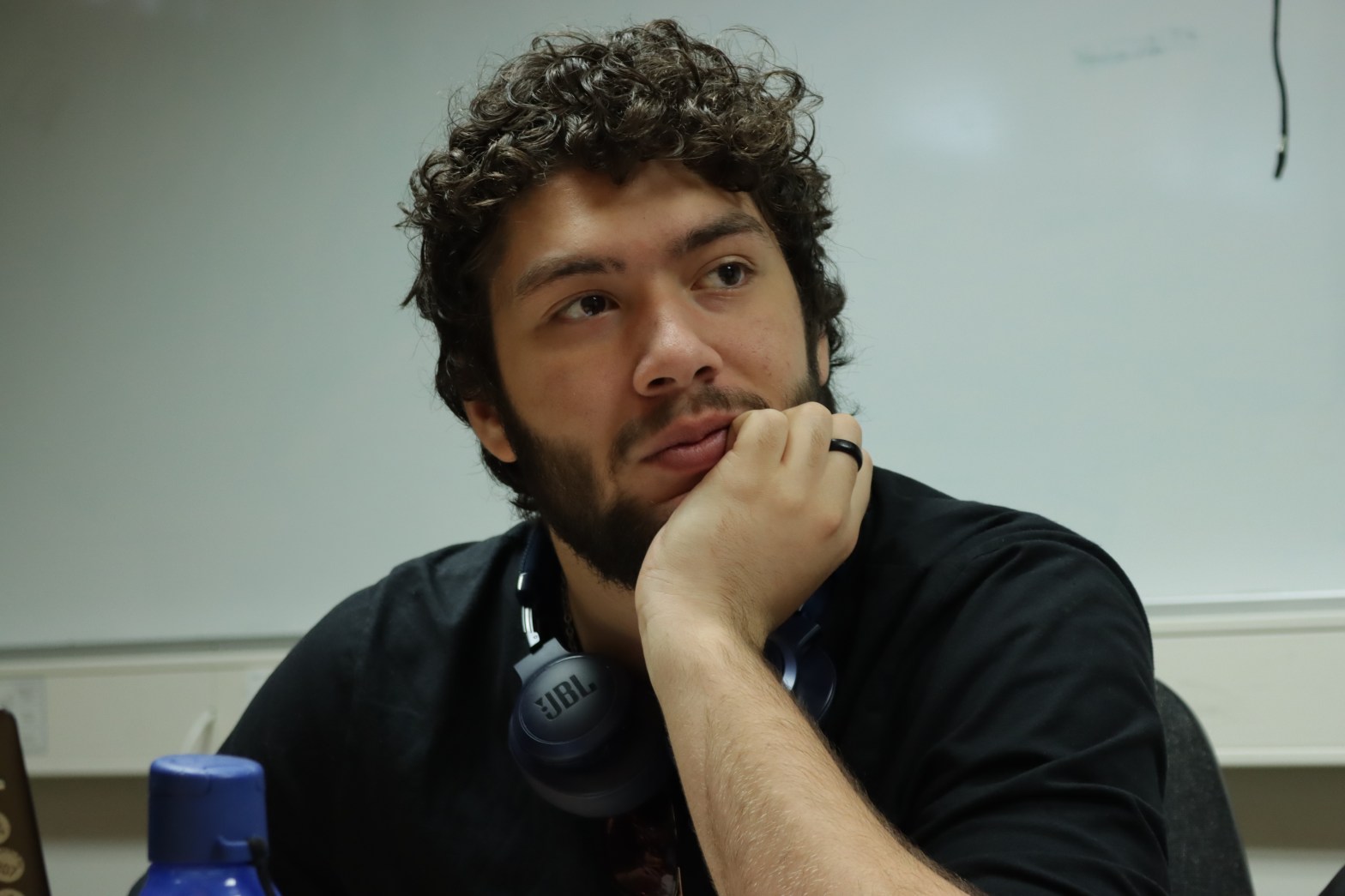
Week 6 – Pettrus C. A. Vizioli

Just call me Sisyttrus, alright?

So, in week’s six exercise we were supposed to make a dialectical montage, which basically means a lot of second unit footage. So, the goal of the exercise was more to find images and videos across the internet that fulfilled the filmic ideas we wanted to present. Our idea was to do the myth of Sisyphus, easy peasy, right?

So, I’ve always studied philosophy, since I was a child. My mother’s idea of great fun was to read Plato’s ‘The Republic’, which is a very nice book indeed, but bot crazy on the fun factor. So I was already familiarized with Camus whole philosophy, The Myth Of Sisyphus being my personal favourite. In the first meeting our director didn’t manage to convey the whole idea and philosophy to the group, so I explained them the basic idea and how Korneliusz wanted to portray it.

Clearly not an eye candy

In my opinion, the best way to have handled the Short was to have it all be stock footage, or footage from Youtube or news outlets. But, as I was the mere sound engineer, and the exercise is not meant to be ‘Pettrus takes over every creative facet of the shorts’ I merely said that that way of handling it was possible.

There is one weird dynamic that I don’t really know how to best approach it without sounding like I’m full of myself: how to hear and follow other people. Right about now it may come across the reader that I’m kind of a bastard. Yes, I know my fair share of film, for a student. But that I’m still kinda pompous and narcissistic. One could also have noticed that the person whom I have disagreed the most in almost every Short was Korneliusz. And that assumption would be correct. We both just have vastly different perspectives in what art is supposed to be, and how someone’s suppose to craft it. With that said, imagine having to work in a project you utterly disagree on how it should be handled. Where literally every choice you’d do differently. It ought to be weird, right? And it was.

But it’s ok to feel weird or even against it, in a creative sense. I’ve learned things that I would’t if I just had gone with the ‘I know best’ routine. But, still, it is a selfish emotion nonetheless. But it is a part of the craft. The fact that, sometimes, you’re not the craftsman. You’re helping the craftsman achieve his vision, just like he did with me.
Week 5 – Pettrus C. A. Vizioli

Nothing

wrong with

getting your

hands dirty

So, this was a wild one. It has been almost a month since I did the part and I still have some bruises from it. Relax, relax, nothing major. Nevertheless, the experience of just giving yourself to a role was quite fun. I never took myself to be an actor or anything like that, I know my limitations. But, from time to time some roles get my attention, especially the ones where words aren’t needed. I was waiting for a week where Aaron would be the Director, just to see what he would come up with. So there we were: his script on our hands, and locations and props to sort out.

I threw myself at mock-5 speed

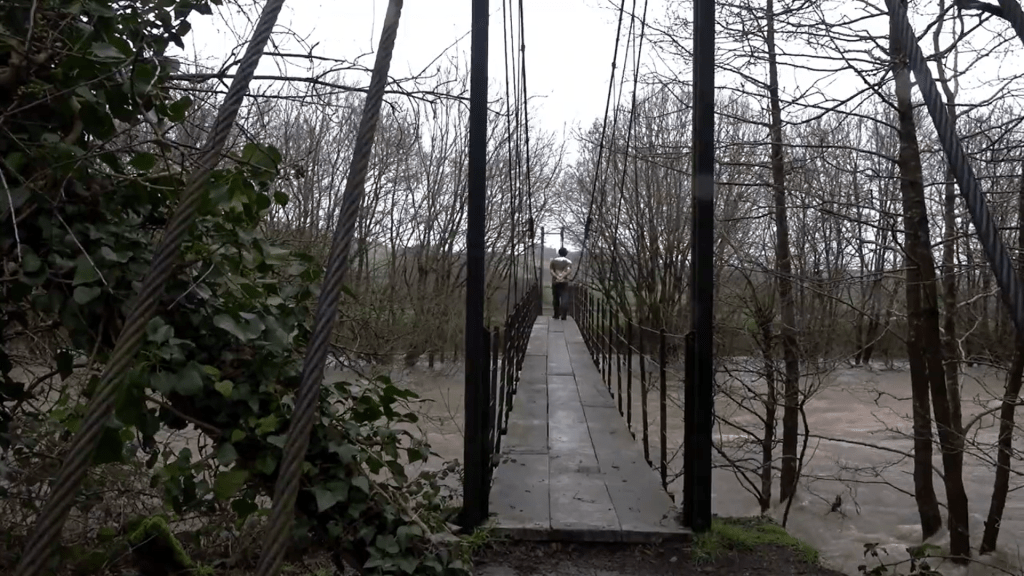
The whole story was a metaphor. We knew that right away. I mean, it’s not that hard, at least from the script to understand clearly what it all meant. The script started with nature shots. Nothing but blissful nature. Then, out of nowhere, the main character, let’s call him Jon would run past the camera, breaking the silence and the stillness of nature. He was running from something, but that something was never shown. The sound of people and metal could be heard ever so slightly on the background. Every step Jon took would have a metallic, lifeless, stamp. He would break branches and leave footprints wherever he went. Oh, and his hands were tied, which is kinda important. Then, after falling and running for some while, he would stop and see a bridge, he would cross it calmly, look back, the metallic sounds wouldn’t be there anymore. He’d free himself from his shackles and catch a breather. Pretty simple, eh?

I always was a

handsome devil

Ok, so, getting out of theory land and coming back to reality, the shooting itself was a bit rocky. Some of the potentially great images weren’t filmed with it’s most power. By that I mean the bridge scene. The shots from the bridge were suppose to look somewhat like that:

But they ended up looking like this:

And the editing was the thing that the whole group disagreed the most. Frankly I didn’t like how the editing turned out. The whole pacing was a bit all over the place and some of the shots lacked focus. Not focus in the sense of the focus on the lenses, but on the eyes of what was important for the frame. There was a lot of dead space and lack of movement.

This is one of the shorts that I plan to try to edit it again at some point in the future, just because I really liked the idea of it. The lesson that I got from this week’s exercise was that theory and practice can vary really easily.

Week 4 – Pettrus C. A. Vizioli

Cinematographer

I have a very serious and totally not fake condition called Visual OCD. That means that I’m super nit picky with images. This weeks exercise was reenacting a scene from Ingmar Bergman’s excellent film Persona. My mother always was a great fan o Bergman’s. I can’t even remember the age that I saw The Seventh Seal for the first time. But, with that said, I’ve never seen Persona before. And I thought of doing something interesting. I wouldn’t watch the film until editing was concluded, just so I could appreciate it more after concluding the making of it. Which was exactly what happened.

My first time

with real

lighting

equipment

Well, lighting equipment is not very easy to come by in Brazil, as most film related equipment’s are very pricey. I’ve watched so many videos about the theory of lighting so I didn’t feel that lost with it, even though I would usually, at least in photography, prefer to use natural lighting. But In film I reckon it needs to be different, everything needs to be, until a certain point, controlled. Weirdly enough my perception with film and photography are vastly different, even if they do meet halfway in some points. I’m a firm believer that photos are meant to represent the world, naturally. Meaning that I always avoid editing my photos too much or at all. With film I feel different. Film is supposed to be a window to a constructed reality, but more so than pictures, in my opinion. Photography is a photograph of reality. Film is the photograph of the photograph.

Well, in this exercise I put my best ability to do it’s magic: work under a tight schedule and a lot of pressure. The thing we didn’t realize was that we only had forty minutes left to shoot the entire picture. We took one hour to set up the first shot. Thirty minutes to set the props. So, after we kept doing and redoing shots of hands banging on a table, we finally started to listen to our producer, who was already saying that we had taken too much time with all that and that the rest of the shooting would be an uphill battle against father time. So, we just put our brains into efficiency mode and started doing every shot in an uncommon amount of time. The first half of the shooting was permeated by a sense of nothingness. I mean, we were doing things, but just tiny adjustments. From those last forty minutes onward we just covered all the ground we needed to end shooting in time. Even the most difficult shots we just needed to do them thrice. I even remembered my teachers words echoing in my head for that shot. “This one will be hell to pull off nicely”, and then, on my first try, I had done it. I felt a strange synergy with the whole group.

I really liked the part where I would just say to Korneliusz where to put the lights and he’d ran to put them in their place. I did that about fifty times. Even felt like just pointing to random places to see him carry it there, and then be like ‘Nah, bro. Never mind, undo the whole thing’.

Week 3 – Pettrus C. A. Vizioli

Editing & Producing

In week’s 2 theme we needed to create a situation based on breach of trust, and think how the mise-en-scène would affect the story and create a sense of space and personality. One of the things carried over from lasts week learning curve was the idea that each character should have a personality and it should be portrayed as soon as the screenwriting. So, one of the things we tried to think of were how each character was, and how they’d be portrayed. My role’s in this weeks exercise was Producing and Editing. So, why should, as an editor, be stressing the importance in how an actor portrays his character? For a fairly simple reason: a lot of the acting comes from editing. Of course that the actor has it’s own merit, but depending on how an editor cuts and positions shots and scenes, it creates a wholly different emotion and tone. And, he also selects which shots are in the movie, with the help of the director. So, some actors, like Joaquin Phoenix, are famous for doing various interpretations for some shots, which, depending on the way the director handles it, create opportunities or losses in post. Opportunities such as a bigger variety of expressions, and losses such as continuity errors.

I always liked editing, ever since I had a English project in my school and I was the only one interested enough to do something real. So, I’ve always been very particular when it comes to timing and cuts, like, really particular. Every frame matters. I could spent fourteen hours editing, as I have before, and I wouldn’t complain about it, unless something like the whole system crashed and nullified all the work I’d done. But, you know, that sometimes happens.

I never had a very structured way to edit the shorts that I was a part of, so finally having a go at creating different files and folders for everything had this weird charm. I felt like a professional, in a way. Even to the point where I could see which shots worked for each interaction or beat that the story had. For example, the beginning of the short was supposed to be just the two talking, changing from wide to wide. There was no inherent problem with that, in the sense that one could understand the story about the same. But we were thinking as someone who knew exactly what was happening in the scene, which the audience wouldn’t at first. Even the whole singing bowl playing was a way to introduce that mystery of “what is happening?”.

Every single minute of editing had some kind of discovery. Even the ending, where we were supposed to see Aaron character’s waking up we just thought: “it’s done, there is no more story to tell”, so it just ended with the same sound that it began, and the hypnotist’s face framed as the forceful and scary person that he was. What I’m getting into is that every single motivation during editing had a reason for it. Pacing: at the beginning it starts normal, as the character is trying to talk to the hypnotist, then as it gets to the countdown it shifts for something rhythmic. Then it slows down as the hypnotist takes his time to open his briefcase and take his card.

I didn’t like how the project was coming together at first. Even knowing that Juliette had a very clear vision to the whole project didn’t help that feeling. I couldn’t see the bigger picture. But whilst editing, that changed. I learned another important lesson: Editing changes everything. Every shot and every sound I was putting together just made me realize the visual of the entire picture more and more. And not necessarily by my editing, but through the entire process of film. It was a blast all the way through.

Producing

So, yeah, just by the contrasting sizes of both texts you can get what is happening. I’m not going to lie,: producing is not my thing, even though it is one of the most important aspects of filmmaking. A producer is the person who sees the whole ordeal, from financing the film, to assembling it. It is vital. With that said, almost half of it is planning, and doing assessments to see the production through. Which I’ve managed to do, but can really tell that it’s not my strong suit.

I sought for us to have The Cwtch, a communal space in the department, and the props for the short. Getting them was fairly easy, as the props were lent by the university, as was the equipment. As everything was already set up by the day the shooting took place, as there wasn’t really a lot to, um, produce, I became more of a b-roller than anything else.

Week 2 – Pettrus C. A. Vizioli

Director & Scriptwriter

How do people from different cultures perceive visual storytelling? That’s what always interested me in film. Growing up in a country that doesn’t speak English I’ve always seen films subtitled, until I finally learned the language, that is. My mother never quite understood English, even to the point that she hated how it sounded. Through my learning phase my mother would often join me in my viewing sessions, and as I never really liked to talk during the film, we just stayed quiet. After each session my mother would debate with me themes and things the film tried to establish and say. The best films, in my point of view, she could understand it all just by the imagery, editing, and directing. Even films that were from vastly different cultures could be understood by a non-speaker if the filmmakers knew what they were doing.

Images speak for

themselves

Visual storytelling was the name of the game. A lot of people, specially filmmaking students, whenever they want create a story they always go for drama. They want to make a deep and philosophical drama with deep and complex relations; which, by itself it’s not a problem, but they want to make it all in three minutes. So the probability of the short being good is fairly low, and that’s beginners were talking about, so inexperience is the norm. When we started debating how we should approach the Short, the group was already on pair with the whole “It Shouldn’t Be Rocket Science” mindset, so, as we only had two days to come up with the idea and script for the Short, we just tried to see if anyone already had an existing script for something that fit the criteria of either “pick-pocketing”, “chase”, or “late again”. I had written the script a few weeks back that fit the theme of late again like a glove, so I presented it to the group and we pretty much settled on it.

There’s a certain magic in the air whenever I’m amidst a shooting. It’s hard to describe, as I don’t even need to be working during the shooting. Once I was walking around through Portugal and found a random shoot for, well, something. I couldn’t really tell what it was for, even though it did seem to serve as some kind of commercial or some sort of heightened reality, as the character were dressed in a very stylized manner. Nevertheless, I just stood there, looking at how they were filming, how the actors were preparing themselves and such. I stayed there for about six hours. Just absorbing that overwhelming sense of aw and belonging. And that was the mindset for when I stepped in for shooting.

Everything

Needs

To Be

Thought

Through

That’s the lesson I got from this Short. I feel like the whole short could have had one more edit, just to tinker a little bit with the sound and the length of some of the shorts. But, as the exercise push us towards trying to release each short without being overly zealous with it, we charged through some of it. Which is the closest to industry standards. The one true flaw in the short came through sound. As the teacher snorted the cocaine, the sound wasn’t put there, even though we had recorded it. As we didn’t put the sound in, it did not convey that the main character heard the whole teacher ordeal, so the final moment doesn’t have that much of a punch. Other than that the whole short was pretty solid, we even thought of it as the one to be used as the final project. Mostly everything is understandable, and we got a very wide variety of shots for each scene.

One of the biggest things that one of our teachers stressed was the fact that the characters should have strong personality traits that could be conveyed easily through visual and costume. Like our main character, we tried making him a very uptight and nervous individual and contrast it with the teacher (the authority figure) who was the complete opposite of what a person expects from an authority figure. Even her office was meant to convey the sloppy state that she choose to work in. One of the problem we had was with the location. We had asked one of the teachers for usage of her office, which she was okay with. But, at the day of shooting she had forgotten about it. That was one of my fears, as back in Brazil I had a lot of shoots with the same thing happened, so was kept that in the back of my mind. I went to her office first thing to see if it would still be available for shooting, which of course it wasn’t. But I managed to secure another teachers office to shoot in, so no harm done.

Here’s a Behind The Scenes of it: https://youtu.be/qK8EKaOCBtQ

Week 5, Aaron Lyttle

FILM: The Disturbance

ROLE: Writer and Director.

This weeks film was to do with sound scape, so our restrictions had us not being able to use the sound captured through the camera, how we would normally do it with a boom pole and also no dialogue was aloud. The sound design had to be captured externally or added in post production after the all the scenes are filmed. This was a very interesting task as really we had to tell story through visualisation and also audio/sound design the give the audience a feel of whats going on.

Since the very beginning of my journey with this module, I’ve been craving the opportunity to actually do something more artistic behind the camera, especially in relation to formulating an idea from the ground up. So I put myself forward for the role of Writer/Director. The group were okay with that and the rest of the group were assigned to their own roles.

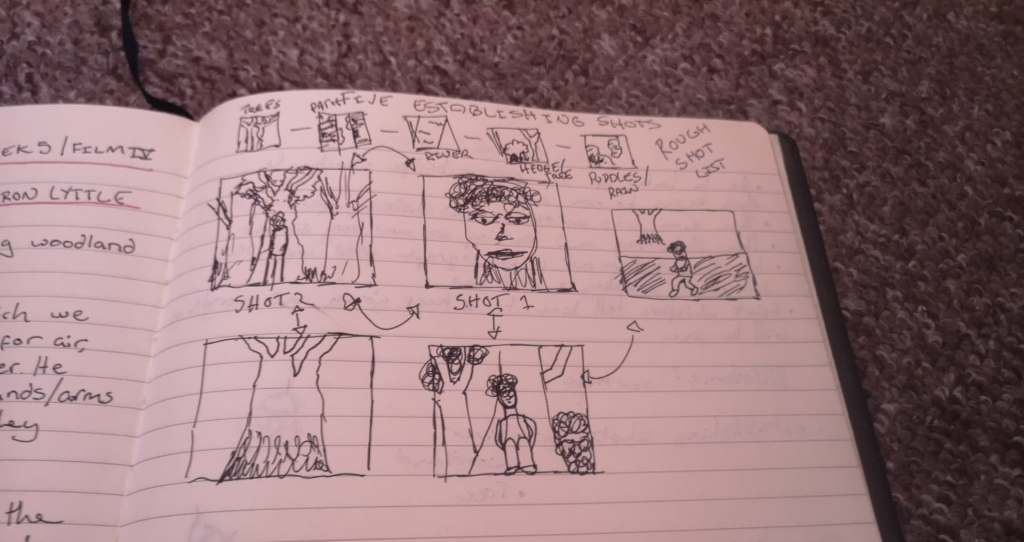
After we got the full rundown of our task. We location scouted in a beautiful area with a woodland environment that had a fast flowing river and also a bridge. I was already starting to piece together the idea in my head, whilst also beginning my partnership with the Cinematographer so I told him a brief outline of the idea I was thinking of so he could draw up some rough story boards.

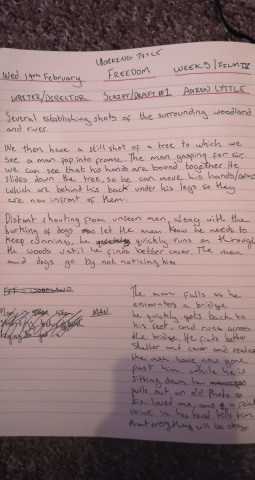
Once back from location scouting, I immediately began my preparation by coming up with a story treatment, like a brief outline of what I had thought of earlier on in the day at the location. The first thing that came to my mind was of someone escaping from unknown captors or entities of some sort. This would fall in line with the no dialogue restrictions, as the one and only character would only have to be shown escaping through the woods trying to escape while the sound design would be focused in the distance giving chase to the escapee.

Rough sketch story board
Initial Title and story treatment

I arranged a meeting with the Cinematographer to sit down a realise it on paper whilst also providing a rough first draft of a script. He then took the script home and prepared the story boards for the film, whilst I prepared myself in the direction of the lead actor during the shoot.

The day of the shoot finally came, with the weather predictably terrible, it was wet, damp and even some of the surrounding areas we would have to film were partially flooded. I knew this would be my biggest challenge yet during the course of this module. But I actually thoroughly enjoyed the challenge, I worked very closely with Tayjib(Cinematographer) and Pettrus(Lead actor). Mainly to make sure I was happy with the shots and to get as much coverage on the day for comfort in editing. We stuck to our initial story board but also came up with some extra ideas on the day of the shoot which enabled us to capture some interesting shots of the surrounding areas. I learned a hell of a lot from Directing by my approach to dealing with actors and trying to get the best possible performance out of them for the camera, but whilst also listening to their own ideas to really try and make the character as authentic as possible.

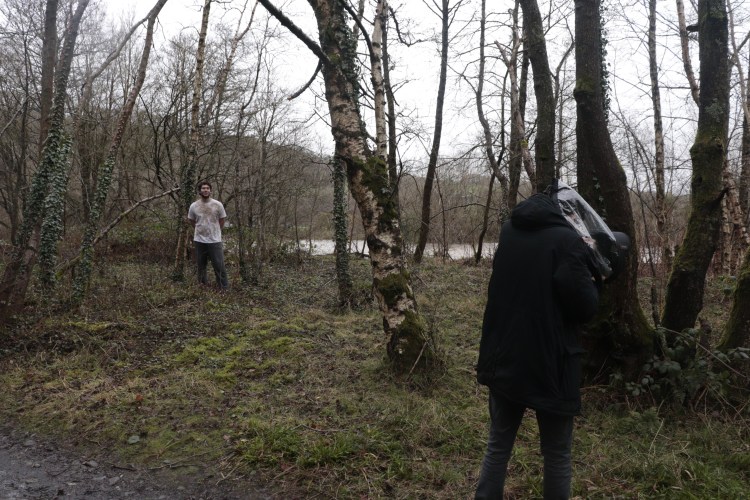
Me (Left) Watching a scene take place.

The Editing process came next, this was putting the jigsaw together and making it as cohesive as possible. There were a few hick ups along the way with editing with disagreements within the group in regards to how a scene were the main character falls into a large puddle and we realised that there was a lack of coverage for this sequence so we had to improvise and ultimately had to use footage we didn’t want to but we blurred it out in editing to make it look like the character was dazed from the fall.

On reflection I fell like I done the best I could have done with this task as Writer and Director. I do feel though that of course there is lots of room for improvement especially in my ability to make sure I get all the shots I need. I ‘m definitely sure I will take a lot away from this and this has only improved my skills.

Week 4, Aaron Lyttle

FILM: Persona Reenactment.

ROLE: Sound.

For this weeks project we had to mimic a scene from the movie Persona. I had done acting in the previous two weeks so now was finally my opportunity to get behind the camera and choose a role. Ultimately I decided to go for the role of Sound technician or Operator. I had never had any experience of doing this before so I snatched at the opportunity to try something new, knowing very little about the role of sound I researched sound design in some of its different areas, and also how it plays a significant importance to making a film work and bringing it together.

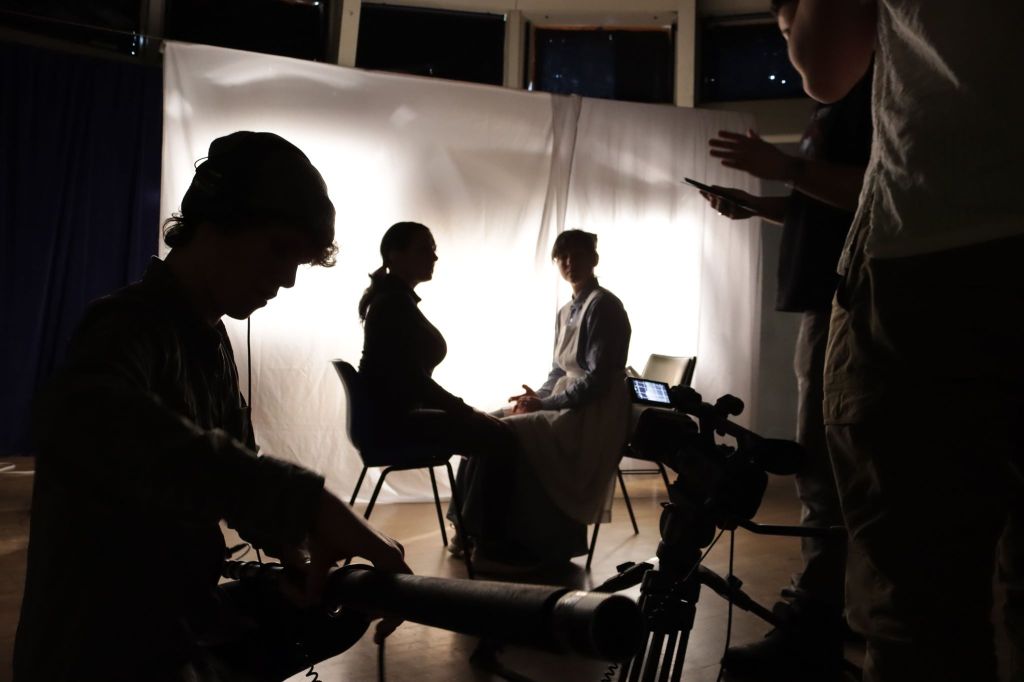
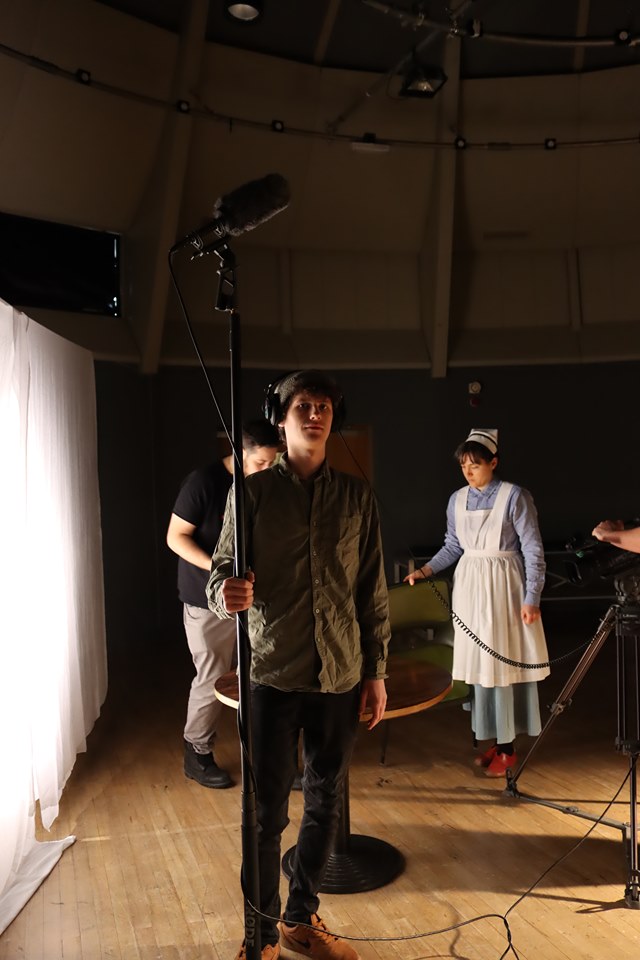
Me(Left) shrouded in darkness as I prepare cabling on the boom mic.

This film was mainly a Lighting task, but Sound came to be very useful in regards to the making of this film. You always have to be ready and on your feet with the boom pole. It can be extremely tiring to do this task because constantly hold the boom mic up high and pointed directly into the Actors chest can be very straining, even after short periods of time. To be honest I did not find myself having to do much in depth preparation when it came to the sound itself. It was simply me making sure that the sound was actually being recorded at all times, checking with the Director after each take to make sure the sound was fully captured. I did this by getting the Director to play back each take and listen to the audio carefully through headphones to make sure I got the best quality audio possible.

Me (Centre) posing with the boom mic, whilst the Director Pettrus (Right) sets up the next shot.

With this shoot coming to an end and a job well done from the team, I was fairly confident even before this film went into post production that it would be a fantastic reenactment. Thanks to the the well produced costumes, pin point directing and lighting, and of course my fingers were crossed that the sound came through okay in editing. I also feel like this is when we really started to become a strong group at this point even with it only being our third film working together.

All in all, post production and editing wrapped up nicely, thankfully with the sound turning out okay, I was relieved and happy, also maybe even surprised at how well it works with the scene, and how strange it would be without the added layer of sound. I thought this was an interesting starter role behind the camera, although I feel like I have only scratched the surface, I’m staying enthusiastic about being able to learn a lot more in the future when it comes to sound.

Weeks 7 & 8 – Juliette

For these weeks, that unfortunately didn’t get to happen as planned due to circumstances outside of our control, I had the planned roles of Editor for the British Realism task and Producer/Actor for our final film. We had already begun to plan both films before being told to skip to the final, and then ultimately the University closing.

Our British Realism concept was a look at racism, xenophobia and very current affairs with an encounter between a British person and an Italian where the British person assumes the Italian has Corona Virus and becomes fearful to be in their presence. With every member of our group being ‘foreign’ in a way we had a somewhat ‘outside looking in’ approach to the assignment. While looking at the hard gritty, reality of Britain and its influence on the rest of the world we entered a deep conversation about our experiences and observations. Unfortunately, we didn’t get to explore this any further as we were told to drop that assignment and go straight to the final film in an attempt to finish it before the University shut down for the Corona Virus.

After the Friday session we went straight into full on planning mode for the final film that we still hoped to film on the following Monday morning. We already had a script and our roles planned out. We each wanted to have another go at what had been our favourite so far. For me that was producing even though I enjoyed every other role very much as well especially editing which I look forward to practicing more over the coming months.

I had an idea for the final film and wrote the script with input from the rest of the group. With it being our final film, it was important that everyone liked the theme and story we were going to tell. This was not an easy compromise to try and work out especially with the time pressure and I ended up feeling like people just didn’t like my idea but we didn’t really have time to come up with a new one. We talked about it and it was more that everyone was feeling very stressed from the situation. Tayjib hadn’t had the chance to direct yet and everyone else had been able to direct their own idea. We decided to film the script we already had on Monday and Tayjib would work on his own idea for us to film later in the week or the following Monday as we still hoped at this point to have two more weeks to work on the final film(s).

Unfortunately, my daughter came down with viral conjunctivitis on Sunday and had to stay home from school on Monday, so I was unable to film. We rearranged to film on Thursday and booked the equipment to do so. However, each day, new developments in the Corona Virus epidemic was causing everyone’s anxiety to spiral. The University closed for lessons on Tuesday and by Thursday it became highly advisable for everyone to stay at home if possible. I still collected the camera equipment and extended it for a week hoping to work on something myself at home. However, my daughter kindly passed the conjunctivitis to me and I couldn’t film or drive to return the camera when the whole country was put on lockdown the following Tuesday overnight.

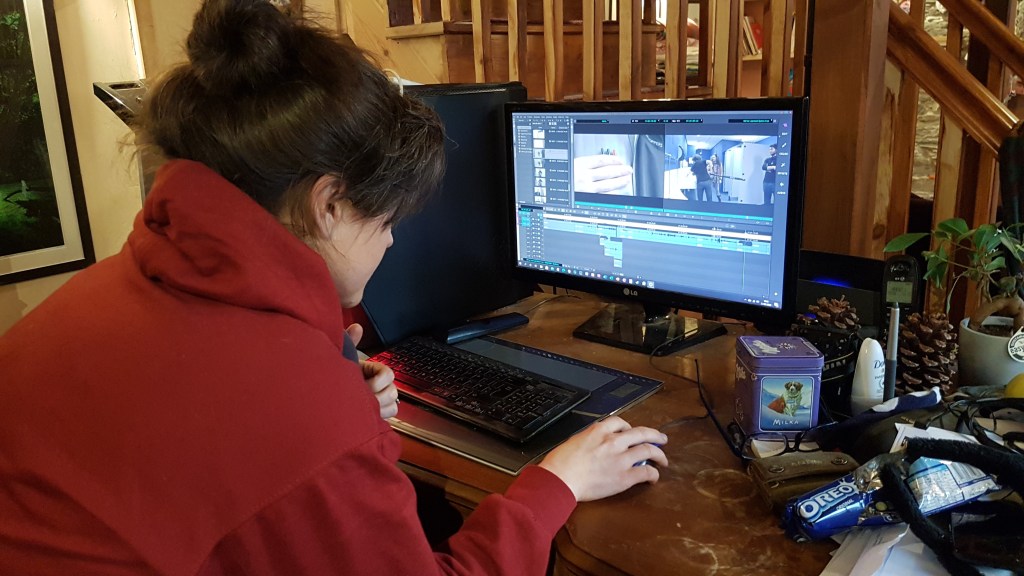
During the first few weeks of lockdown, while I was still motivatied, I set to work making a complilation video from the ammassed footage of our 5 films. I watched through all of the footage to find special moments, outtakes, bloopers but also the best moments to tell the story of our journey. I hit a snag with Avid and between Easter and working remotely I was only yesterday able to fix and finish it thanks to the help of Siencyn. I am happy to present to you – ‘ We’ve Learned Quite A Lot.’

Being able to finish that may have been just the thing to reegnite my motivation and I hope to put the camera I have to work, documenting and creating films from home for the remainder of the lock down.

I am very much looking forward to getting back to University and working together again.

Week 6, Lighting Technician (Daniele)

Welcome to week 6. This week was on Dialectical Montage, a style of editing, using second photography footage. For this short film, I had the role of the Lighting technician. My job was mainly on the filming day; illuminate the set. I strictly worked with the cinematographer and director. In movies, lights need to have a meaning, “where this light comes from”, for the story, the location, and for continuity. Lights is a tool of storytelling in the hands of the cinematographer and the director.

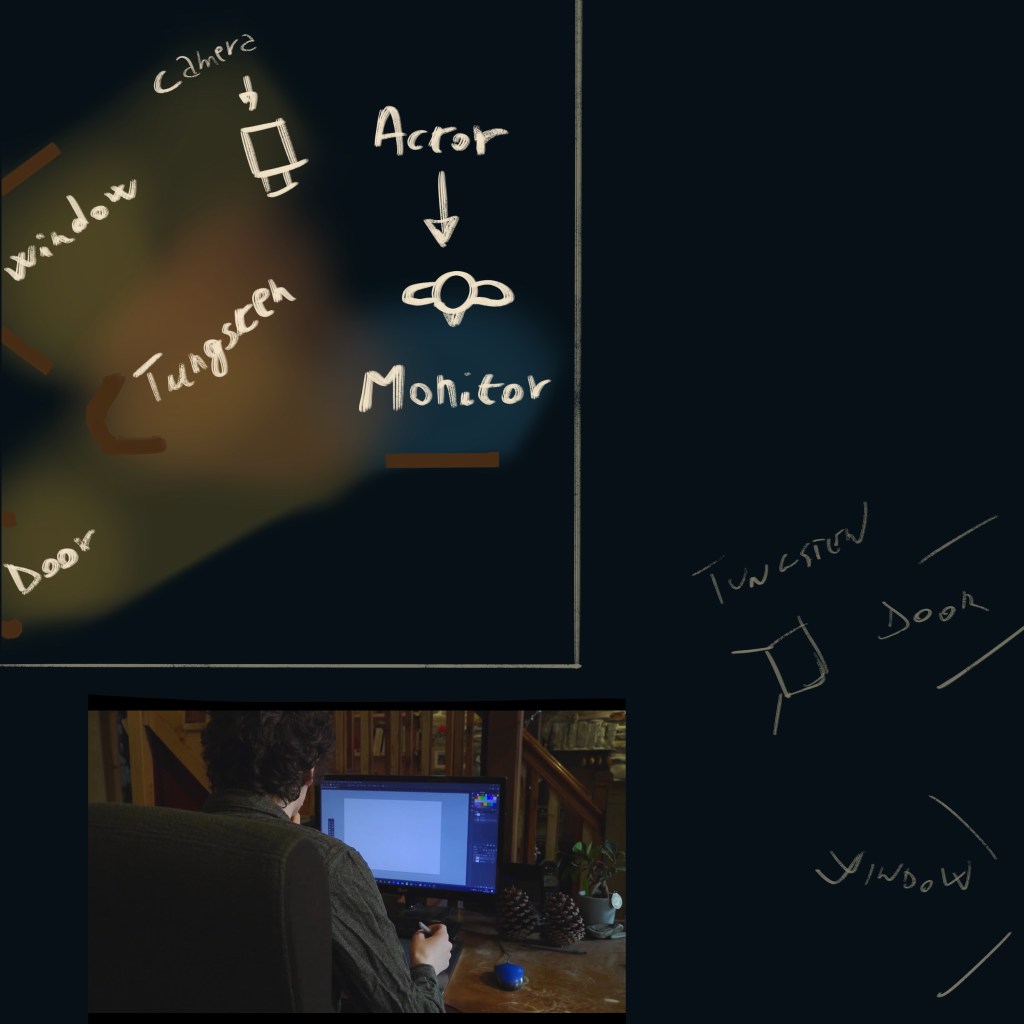
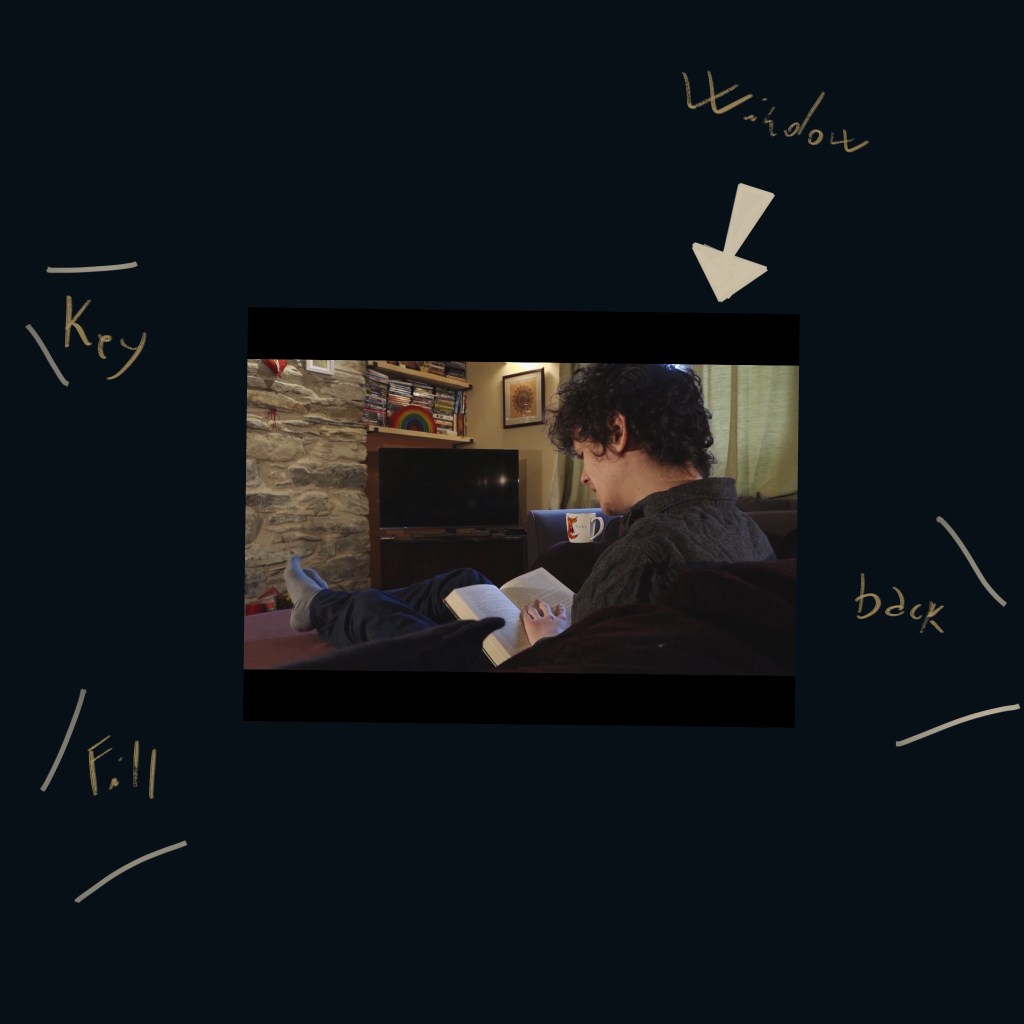
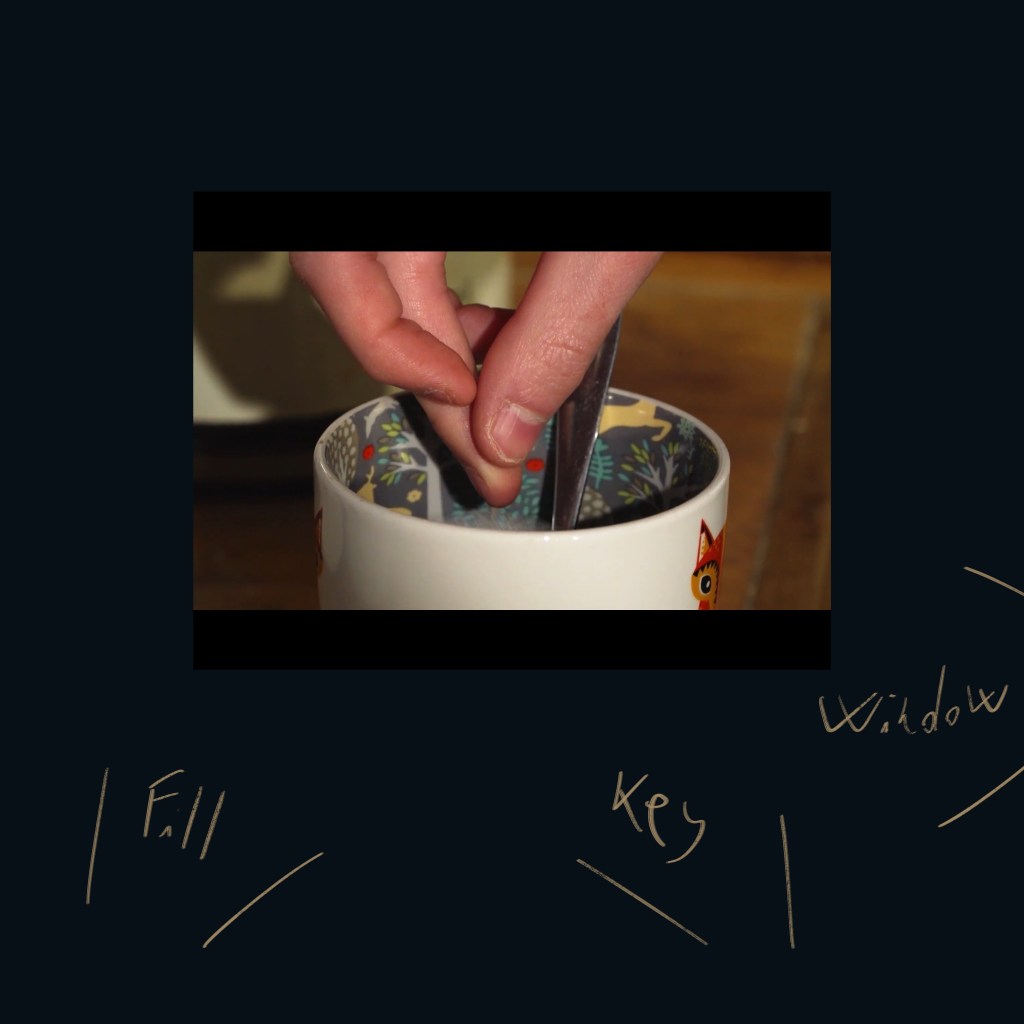
For the scenes in the house I mostly used the three points Hollywood lighting scheme; Key light, fill light and backlight. For the scene were Aaron is working we have natural daylight from the window and the door (backlight and fill light), the light coming from the monitor (fill light) and a Tungsten light as a key light (Figure 1). For the scene on the living room, we used three tungsten lights and the daylight from the window (Figure 2). For the scene in the kitchen, we used two tungsten lights and the daylight from the window (Figure 3).

Unfortunately, because of the COVID-19, this is our last video for this module. Overall, I think that our group worked well; we learnt a lot, we understood what we did wrong and what we did well.  After these weeks I’m more than sure that I will be cinematographer and director.

Figure 1, Lighting scheme
Figure 2, Lighting scheme
Figure 3, Lighting scheme

Week 5, Producer and Colourist (Daniele)

This week the exercise was centred on sound. The task was to make a video using sounds recorded separately with a Tascam and sound effects. The main point of this exercise was to explore one of the fundamental roles in film production, the sound designer.

It’s important to think in advance, during the pre-production phase, which kind of sounds are needed; for environment, emotion, concrete and transition.

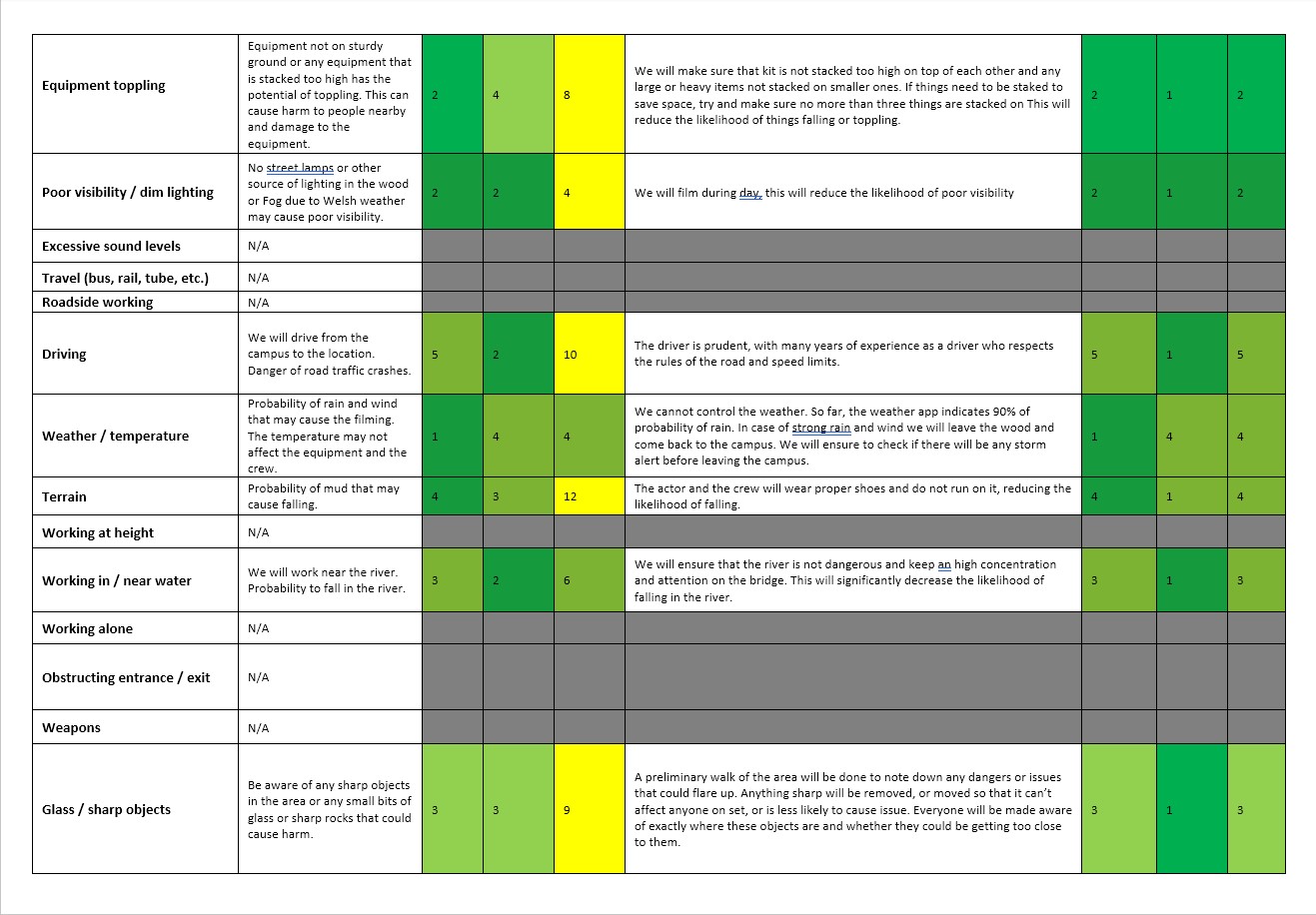
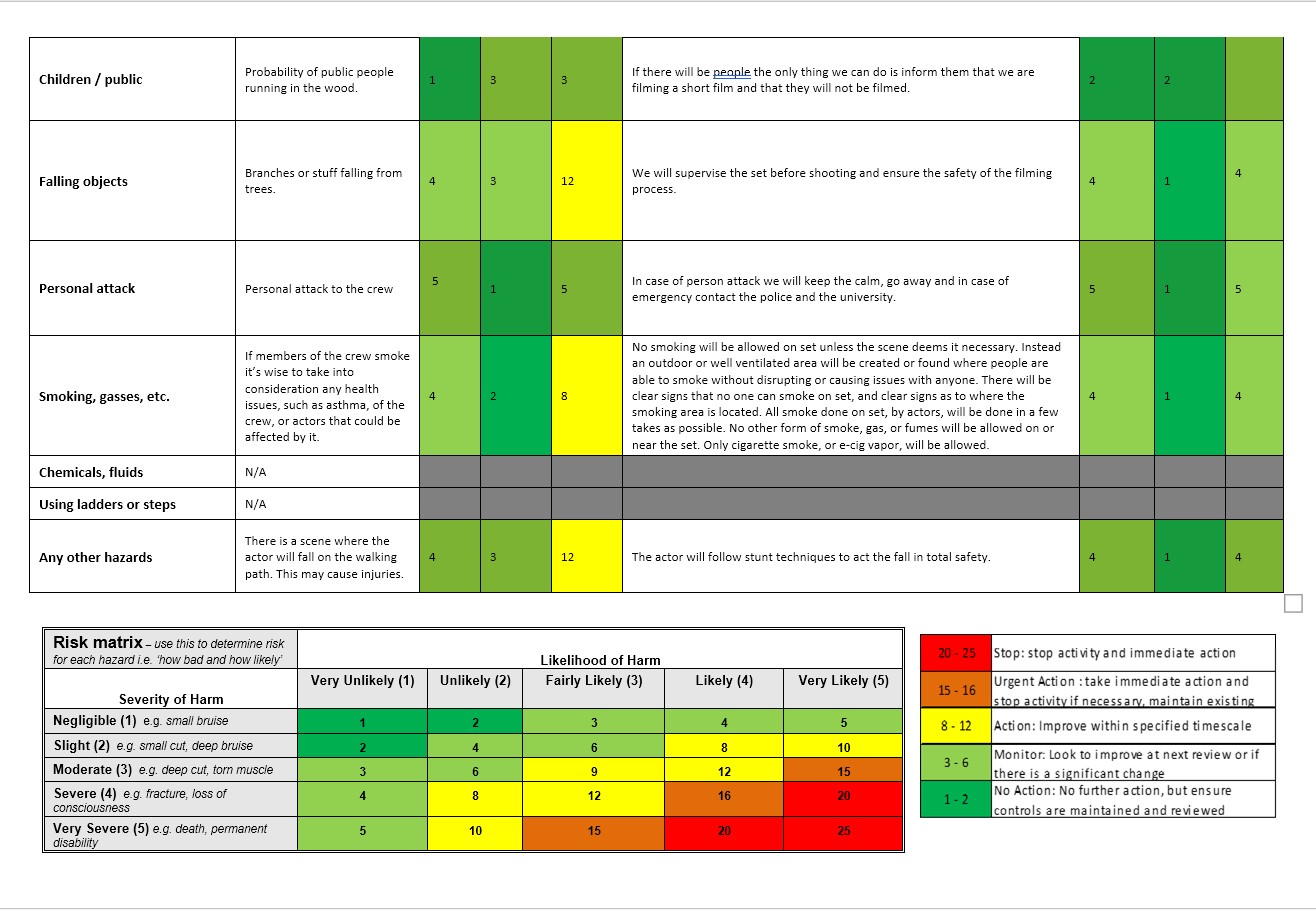
I was the producer of this short film and while exploring the location, a few days before the production, I looked for those elements that would be dangerous or a problem for our filming process; the scene on the bridge was the one that gave me more thoughts. It was not easy to fill the risk assessment form (Figure 1 and 2), I admit that this short movie, because of the kind of scenes, was a bit dangerous if we didn’t pay attention on some details. On the shooting day, I ensured that everything was safe for the crew and the equipment. We are still alive and safe, for now.

I have to admit that I wasn’t so enthusiastic about this movie. Even if I like producing, I have to put the hand on the camera (as director and cinematographer) and work on the picture, but I didn’t. However, I had the opportunity to work on colour correction. One problem. Because of the location, some shots were flat and some had some parts burnt. As I said in the previous post, we are filming in REC.709 (to make it easy, less information/data) which is not the best for colour correction. I worked on this with the cinematographer in post-production but even if it is not the best it is not the main problem of this video. I think that the main problem is on continuity and narration. 

Design a site like this with WordPress.com
Get started